

Stainless Steel Crowns, MRI and Nickel: What to Tell Parents and Physicians
Are pediatric stainless steel crowns MRI safe? Do they contain nickel or mercury? Evidence-based answers for dentists, plus plain-language scripts for parents.
By the KTR Crowns team · · 6 min read
Sooner or later a parent, a pediatrician or a radiology scheduler asks about a child's stainless steel crowns. Is the MRI safe? Is the child allergic to the metal? Is there mercury in it? The questions are reasonable, the answers are mostly reassuring, and a few details are worth getting exactly right. This guide covers what the evidence and the KTR stainless steel crown IFU actually say.
Quick answers
| Question | Short answer |
|---|---|
| Is a stainless steel crown safe in an MRI? | Physical risk is low. The real issue is image artifacts near the mouth. |
| Do the crowns need to come off before an MRI? | Not routinely. The imaging team decides case by case. |
| Are stainless steel crowns magnetic? | Type 304 steel is largely non-ferromagnetic, or only weakly magnetic. |
| Do they contain nickel? | Yes. They are nickel-chromium stainless steel. |
| Can a child be allergic? | Rarely, yes. Known nickel or chromium hypersensitivity is a contraindication. |
| Do they contain mercury? | No. Mercury is a component of amalgam, not stainless steel. |
What KTR stainless steel crowns are made of
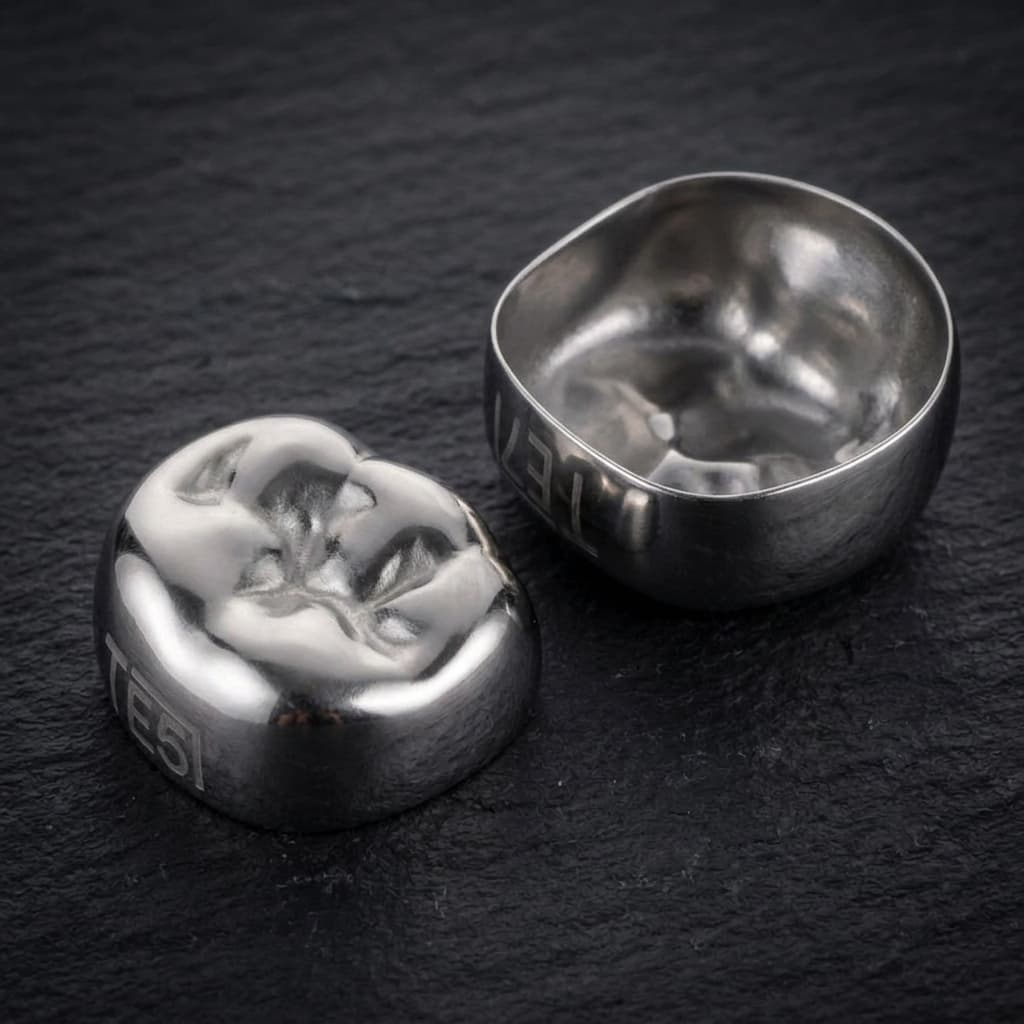
KTR stainless steel crowns are manufactured from medical-grade 300-series (Type 304) nickel-chromium stainless steel. It is an austenitic stainless steel: iron alloyed mainly with chromium and nickel. The chromium forms the passive surface layer that gives stainless steel its corrosion resistance. The crowns are polished without chemical surface treatments or coatings.
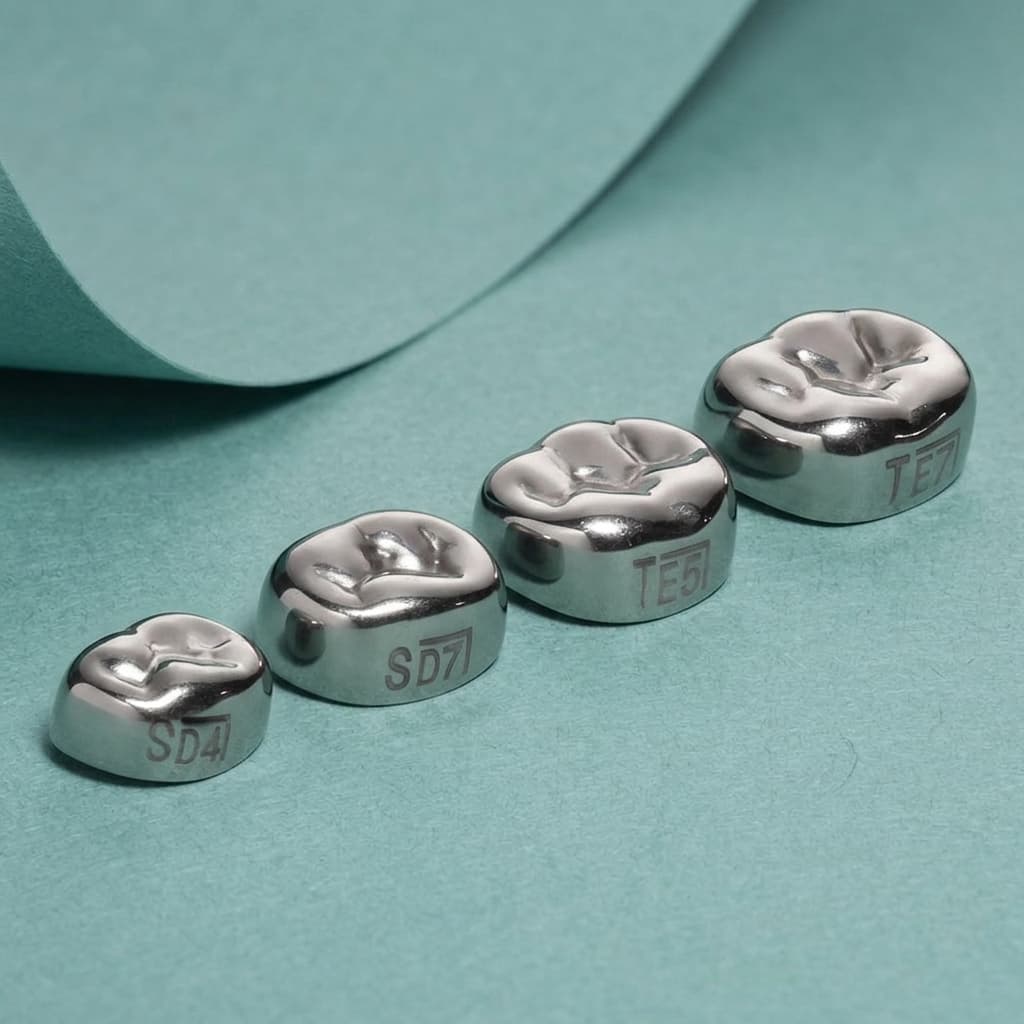
Type 304 steel, 48 sizes
Stainless Steel Crowns
Stainless steel crowns and MRI
The IFU separates two questions that often get blended together: is the scan physically safe for the child, and will the crowns affect the image?
Physical safety: low risk
Type 304 stainless steel is largely non-ferromagnetic or only weakly magnetic, so a cemented crown is unlikely to be pulled off the tooth or to heat significantly during a standard MRI. A scoping review of preformed metal crowns and MRI in the European Archives of Paediatric Dentistry found no evidence of crown displacement, while cautioning that the evidence base is thin and mostly laboratory-based.
Image quality: the real concern
Stainless steel creates susceptibility artifacts: areas of signal loss and distortion that appear as dark voids or warped lines on the scan. In a retrospective study of children who had head MRIs, published in the International Journal of Paediatric Dentistry, preformed metal crowns were the only common restorative material associated with artifacts. More crowns meant larger artifacts, and almost all distortion stayed in the oral cavity and maxillary sinus rather than the diagnostic brain area.
Location is what matters. The scoping review notes that distortion is greatest when the region of interest is within about 10 cm of the metal. A scan of the knee, spine or abdomen is unaffected. Scans of the jaw, tongue, skull base, pituitary or inner ear are where crowns can get in the way.
Do the crowns need to be removed?
Not as a routine. The scoping review concludes that removal cannot be routinely indicated for every patient, and that the decision should be made case by case with input from everyone involved in the child's care. In practice, that means the imaging team decides, based on the region being scanned and the sequences they plan to use. Technologists can often adjust pulse sequences to reduce metal artifact.
Children who will need repeated head MRIs
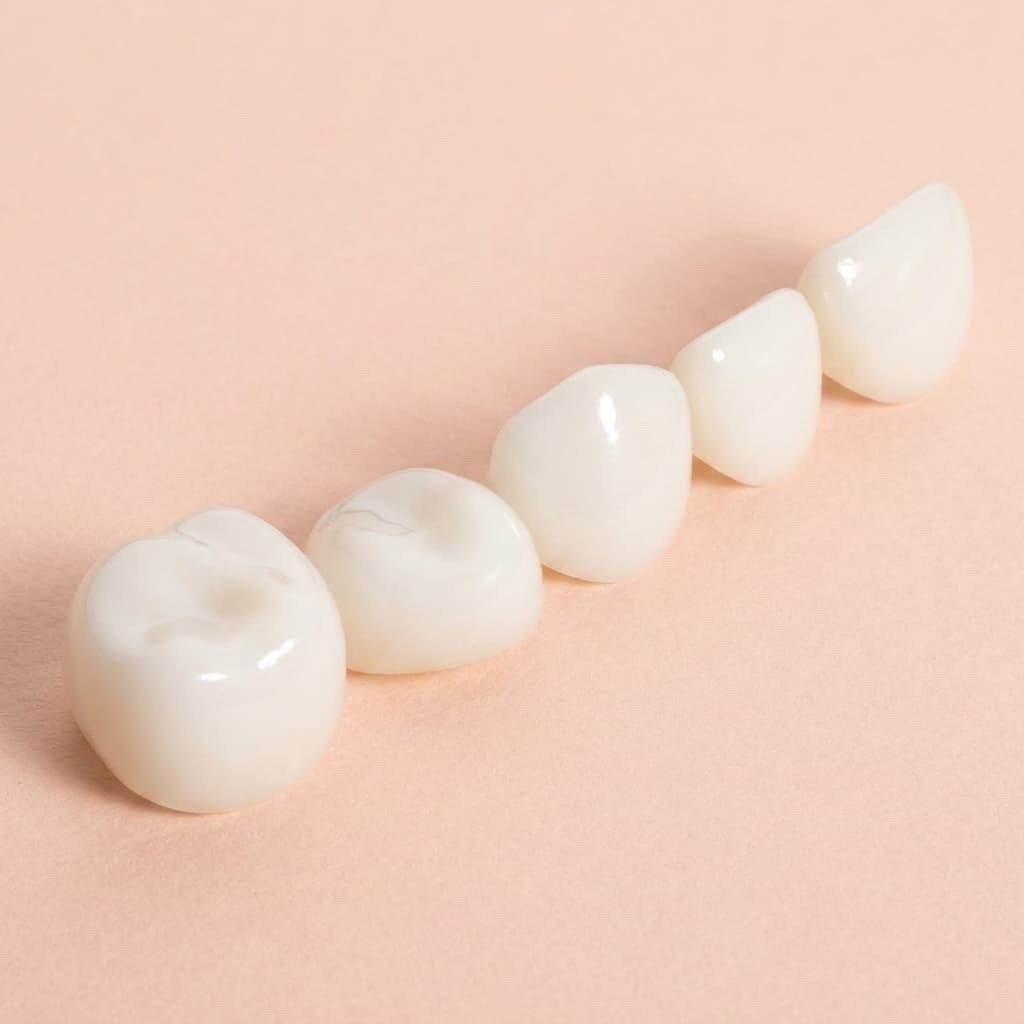
For a child with a condition that calls for frequent brain or head imaging (oncology and neurology patients, for example), material choice deserves a conversation before treatment. An in vitro study from the Hospital for Sick Children in Toronto, also in the European Archives of Paediatric Dentistry, measured an average artifact of 54.9 mm around preformed metal crowns versus 12.8 mm around zirconia crowns. The authors suggest zirconia crowns may be considered when the brain areas that need imaging make metal crowns a poor fit. KTR zirconia crowns are 100% metal-free. See zirconia vs. stainless steel crowns for the clinical trade-offs.
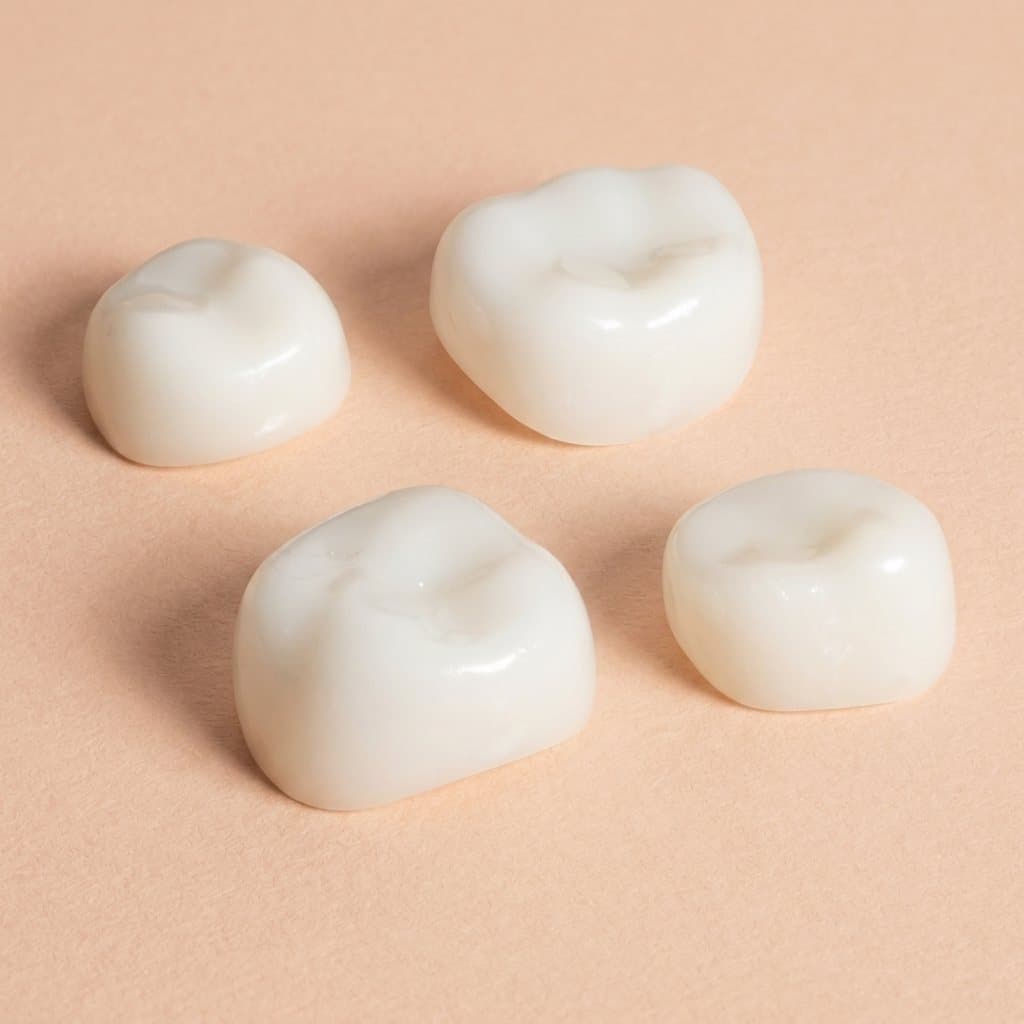
Metal-free alternative
Zirconia Starter Kits
Nickel and chromium sensitivity
Stainless steel crowns do contain nickel, and nickel is one of the most common causes of allergic contact dermatitis. The KTR IFU is direct about it: a small portion of patients may be hypersensitive to nickel or chromium, crowns should not be used in patients with a known hypersensitivity to either metal, and any patient who shows allergic signs should be referred to a medical professional.
Sensitization and a clinical reaction to a crown are not the same thing. In an older patch-test study of 700 children published in Pediatric Dentistry (1988), about 8% tested positive for nickel sensitivity. Most of those children would never react to an intraoral crown, and documented reactions to stainless steel crowns appear mainly as case reports, such as perioral skin eruptions that resolved after the crown was removed.
Screening before you place a crown
- Ask about known metal allergy on the health history, in plain words: "Has your child ever reacted to jewelry, belt buckles, snaps or watches?"
- Ask about any prior patch testing or a dermatologist's diagnosis.
- For a known nickel or chromium allergy, use a metal-free restoration. Zirconia is the obvious choice for full coverage.
- After placement, watch for gingival inflammation or perioral rash that is out of proportion to plaque control, and refer if allergy is suspected.
Mercury and the "toxic" question
Parents sometimes search whether stainless steel crowns contain mercury, usually because they have heard about silver fillings. They do not. Mercury is a component of dental amalgam; stainless steel is an iron alloy with chromium and nickel. Stainless steel crowns have decades of clinical use on primary molars, and apart from the rare nickel or chromium hypersensitivity covered above, there is no credible evidence that they are toxic to children.
Plain-language answers for parents
- "Is it safe for an MRI?" Yes. The crown won't move or heat up. It can blur pictures of the mouth area, so always tell the MRI team it's there.
- "Does it have nickel?" Yes, like most stainless steel. Reactions are rare. If your child has a known metal allergy, we will use a white, metal-free crown instead.
- "Is there mercury in it?" No. Mercury is in some old-style silver fillings, not in stainless steel crowns.
- "Is it permanent?" No. The crown comes out with the baby tooth when the adult tooth is ready.
For more language you can borrow, see explaining crowns to parents, or hand families the printable parent brochure.
Frequently asked questions
Is a stainless steel crown safe for MRI?
Yes, in terms of physical risk. Type 304 stainless steel is largely non-ferromagnetic or only weakly magnetic, so a cemented crown is unlikely to move or heat significantly. The concern is image artifacts on head and neck scans, so the imaging team should always be told the crowns are there.
Do stainless steel crowns have nickel?
Yes. KTR stainless steel crowns are made from medical-grade 300-series (Type 304) nickel-chromium stainless steel. They should not be used in patients with a known nickel or chromium hypersensitivity; zirconia is a metal-free alternative.
Is a stainless steel crown magnetic?
Only weakly, if at all. Type 304 is an austenitic stainless steel that is largely non-ferromagnetic, which is why the MRI risk is low. It still distorts the local magnetic field enough to cause image artifacts near the mouth.
Does a stainless steel crown have mercury?
No. Mercury is a component of dental amalgam. Stainless steel is an iron alloy with chromium and nickel.
Are stainless steel crowns safe for kids?
Yes. They have decades of clinical use on primary molars. The main exception is a child with a known nickel or chromium allergy, who should receive a metal-free crown instead.
This article is general information for dental professionals. It does not replace clinical judgment, the product's instructions for use, or current AAPD guidance. Questions about a specific case? Call us at 1-800-506-5108.
Have a technique or case worth sharing?
We publish guest articles by pediatric dentists, residents and educators. Pitch an idea and write for colleagues.